
By Frannie Parkinson
Before heading out to the mountains, I find that along with the excitement, doubt and fear also start to slowly creep in as the launch date nears. Am I physically and mentally ready? My ankle feels funny; is that going to be a problem? Am I packing enough food? Will I get along with the rest of the group? Will I make it to the summit? This trip to Glacier Peak was no exception. The doubts and fears were definitely present as I organized my gear to fly across the country from Virginia to Washington State, a place I had never visited, to summit Washington's most remote volcano with a group of women I had never met before.
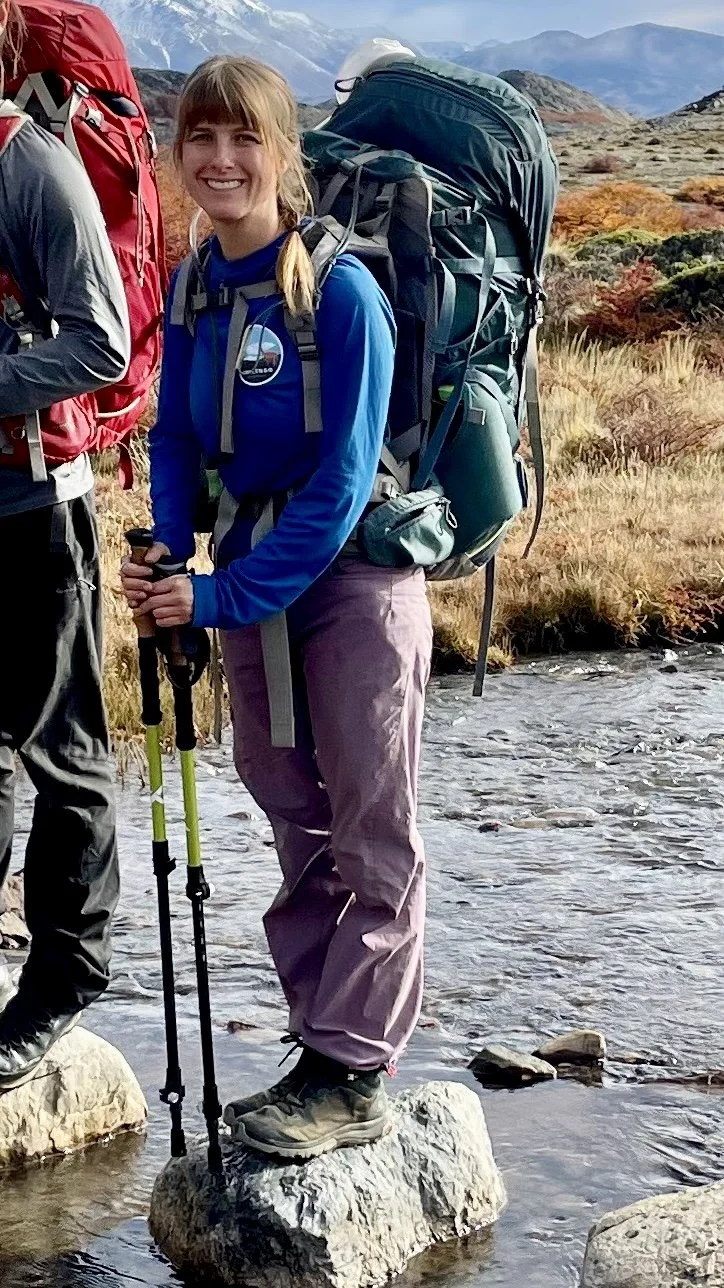
Our all-female group of 2 guides and 4 participants consisted of 6 women (passionate mountain guides, compassionate healthcare workers, and an impressive engineer). On the first day, as we settled into our groove along the trail, we chatted, learned about each other's personal lives and outdoor experience (ranging from new to backpacking to experienced in mountaineering), and I was reminded that traveling in an all-female group naturally leads to connection - unfortunately, every woman on the trail knows what it's like to feel underestimated, undervalued, and unheard.
This felt even more poignant as I noticed that of the many friendly people we passed on the trail that first day, we saw only one other entirely female group (who, of course, greeted us with enthusiastic hellos and words of encouragement). I marveled at the green landscape, wildflowers, and chunky marmots and at how strong, competent, and positive our all-female group was. There was no judgement or fear of being seen as weak or unknowledgeable. I felt free to ask even the smallest of questions, and at no moment did I feel that I needed to pretend that I knew what I was doing. This type of emotional security and support is something often found in all-female groups and is vital to growing competence and confidence in the mountains and in life. As we hiked into our first camp, I felt so lucky to be able to trust and learn alongside women I had met only 24 hours ago.
The following morning, we set out for basecamp and enjoyed the stunning alpine meadows, glacial lakes, and rocky terrain. After a few hours, we arrived at camp, set up camp in the wind, and headed to a nearby snowy slope for "snow school," where we learned the basics of rope-team travel, how to put on our crampons, and use the ice axe for self-arrest (i.e., how to stop yourself from sliding to your death off of the mountain or into a crevasse). While I am very comfortable hiking and backpacking, now in the snow I was really out of my element. I later shared my thoughts with the group, "Does anyone else ever have the thought, 'Why can't I just be a "normal" person and be content staying at home?'" We laughed as someone shared that when a guy she was dating learned that she was into mountaineering, he asked, "So what's wrong with you?"
My experience in the snow is limited, and I felt so unsure of my body. Peace and calm are the opposite of what I felt in snow school. I was reminded that it's so easy to forget how uncomfortable it is to learn something new! You make mistakes, you immediately forget the instructions that were just explained to you, so you have to ask again, and you have to ask for help. Things that I find are not easy to do.
Summit Day. We woke up in the dark for our alpine start, having carefully packed our bags the night before, slurped down some oatmeal, shed our extra layers, turned on the headlamps, and off we went. After many years of backpacking, this alpine start thing was new to me, and although it was cold and dark, it was incredibly peaceful (even in the snow!). Buddhists believe that the morning hours before dawn are an auspicious time, ideal for clearing your mind and starting the day anew, and I couldn't have agreed more as the sun slowly started to rise and we realized that we were walking in the clouds. After an hour or so of traversing up and down some snowy paths, we arrived at the glacier, divided into our rope teams, put on our harnesses and crampons, roped in, and continued our methodical ascent to the summit.
I find that during an expedition, I don't really have a sense of what exactly I am learning from the landscape and the people walking beside me. These reflections often come later, in the comfort of home after hanging out my sleeping bag to dry and throwing my clothes in the wash. However, this experience was different. A lightbulb went off in my head almost immediately when we began our descent from the summit of Glacier Peak.
As we entered into the final push to the summit, an approximately 200-meter, 40-degree snowy slope made up of kicked-in snow stairs, I kept my eyes ahead of me as I felt an intense rush of my fear of heights come over me. I quickly pushed down the fear and focused on putting one foot in front of another. In an anticlimactic fashion, we were soon pummeled again by the wind, and we were on top of the ridge, surrounded by a swirl of cloud, and I asked, "Oh, are we at the top?" Indeed, we had arrived!
While I imagine most would assume that summiting is THE exciting moment on a trip like this, with dread I realized my "true summit" was yet to be tackled, as I turned to our guide to warn her that I was freaked out about the steep descent and might start crying on the way down. I gnawed on a block of cheese and cheered for my new friends as the second rope team soon reached the summit. We celebrated with photos and glitter, and then (much sooner than I would have liked), it was time to head down the mountain. Realizing that I was to lead my rope team down, I panicked and told my teammates I was terrified and maybe someone else would like to go first? I was immensely relieved when my teammate confidently responded she could lead us down. I took a deep breath, said a quick prayer, "Feet don't fail me now!", and down we went.
Shockingly, to me at least, my fears of descending were not valid. I felt solid on the snow steps carved out from the footsteps of previous climbers and supported by my rope team. I found that the descent was actually, dare I say, not that bad?! We were soon greeted with beautiful views of the glacier now visible to us for the first time in the daylight as we took the next few hours to make our way back to basecamp. Somewhere along the return trail, I realized that I was not alone in my fears: my teammates had been carrying their own fears with them, "not being in mountain-climbing shape," "experiencing severe knee pain from an old injury," "being too slow to reach the summit." Being in a group of supportive women allowed for all of us to feel comfortable in sharing our fears, something I rarely feel in a mixed-gender group. Reflecting now on our group debrief at a picnic table at the trailhead, I see how each one of us individually realized that our deepest fears on this trip did not come true, not even close. While it is always important to listen to your body and know your limitations, this experience taught me that it is also equally important to trust in yourself and your ability to push through the fears both on and off of the mountain.
Speaking with a wise friend the other day, she wisely commented that she has learned that when you feel slightly terrified to do something new, this often always means that you are moving in exactly the right direction. My experience on Glacier Peak was definitely a big step in the right direction! It taught me that fear, however well-intentioned it may be in keeping us safe, is often not rooted in reality. Our fears as women (I'm not strong enough, I'm not fast enough, I don't know enough, etc.), while valid, are often simply not true. To quote our guide and founder of Upward Transition Institute, Victoria Garvin, "Do it scared. You do not have to do it confident the first time. You can do anything scared." My experience on Glacier Peak taught me that women's innate communication skills, tendency towards compassion, tenacity and willingness to aid in supporting group goals are vital to any successful expedition. Most importantly, I learned that I can do it scared. And if you are reading this, so can you.
Thank you to Summit Scholarship and its sponsors for this profound experience and to Upward Transitions Institute and our guides Vic and Izzy for their guidance, patience, and wisdom, and finally to my teammates, Carry, Allegra, and Sarah, for your camaraderie, perseverance, and kindness. I am beyond grateful.